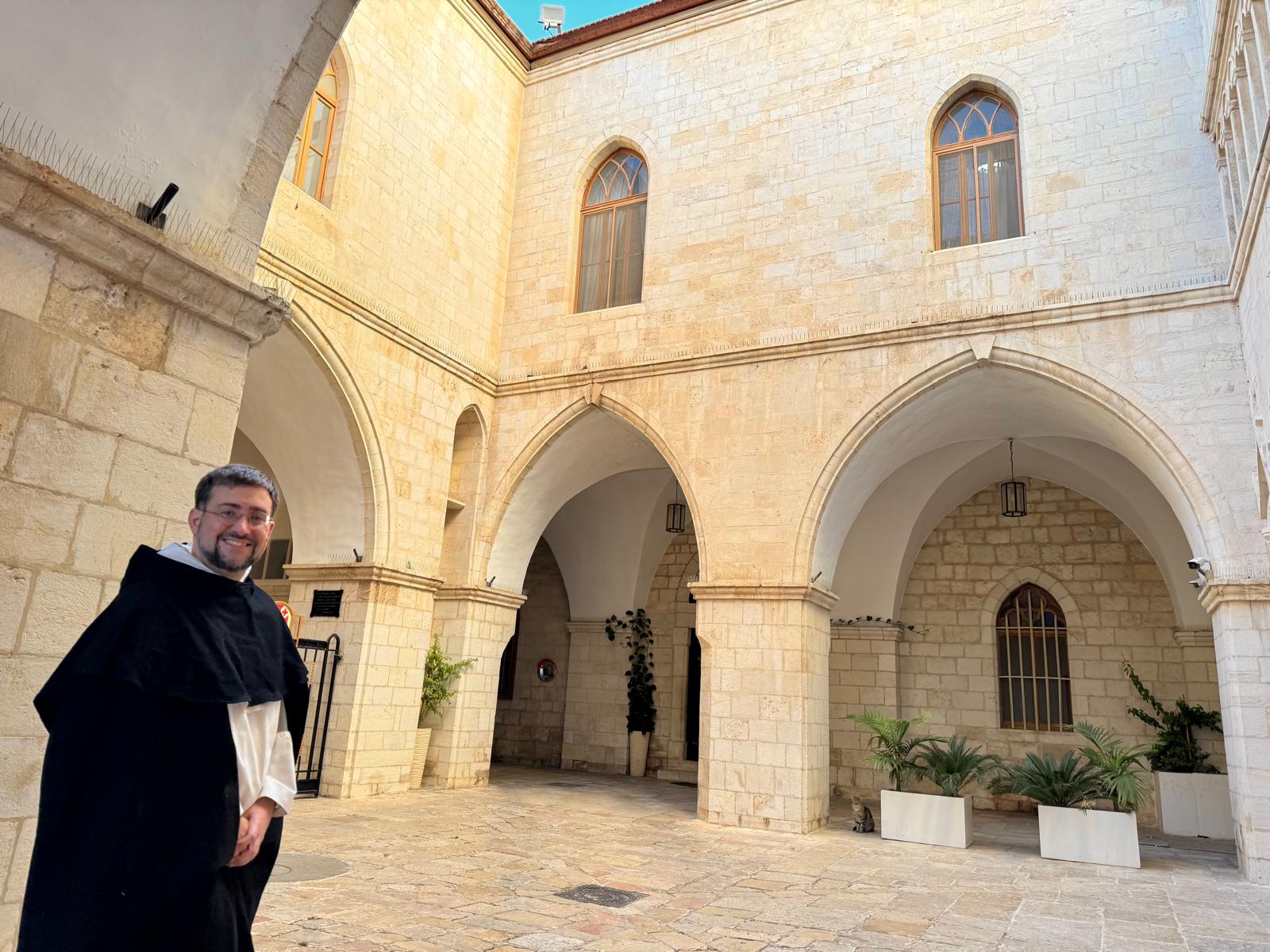
After serving for two years as Prior of the Dominican community in Geneva, Brother Pierre de Marolles has now been assigned to Jerusalem to continue his doctoral research on the Book of Revelation (a.k.a. Apocalypse of John). Born in Versailles and having spent part of his childhood in Switzerland, he first studied mathematics before entering the Order of Preachers. His spiritual and intellectual journey has taken him from the favelas of Brazil to the lecture halls of the University of Fribourg, and then to the libraries of Louvain-la-Neuve and Geneva. His doctoral thesis explores how the mysterious “book sealed with seven seals” (Rev 5) has been interpreted over the centuries. An encounter with a biblical scholar passionate about the life of texts and the way they nourish the faith of believers.
Brother Pierre, could you present your thesis on Revelation? What drew you to this particular book?
I had known for a long time that I would work on the Book of Revelation. It is a text that has always intrigued me. What is astonishing is that it is both very well known and yet profoundly misunderstood. Everyone thinks they know what it contains — the horsemen, the trumpets, the end of the world… — whereas, in reality, very few actually read it properly. Revelation exerts a kind of fascination, but often for the wrong reasons.
So you want to take a new look a book that is usually mischaracterised…
Exactly. So many believers could find genuine treasures there for their faith. It is a text of immense theological and artistic power. Why continue to deprive ourselves of the book that inspired the mosaics of the Roman basilicas, the tapestries of the Château d’Angers and the Ghent Altarpiece of the Mystical Lamb?
But how did the idea of making it the topic of your thesis come about?
It developed while I was working on my Master’s dissertation — on an ancient commentary. At that time, I met Régis Burnet, Professor of the New Testament in Louvain-la-Neuve, a specialist in the history of the reception of biblical texts. He was just beginning to take a particular interest in Revelation, and I knew he would be a good doctoral supervisor. As I was then living in Zurich, we planned a joint supervision arrangement with the Faculty of Theology in Geneva, together with Prof. Anne-Catherine Baudoin. Together, we chose to study how the image of the “book sealed with seven seals”, in chapter 5, has been interpreted throughout history.
“The book with seven seals” — it sounds like the title of a novel!
Yes, it has something mysterious about it. And it has fascinated readers for two millennia. To avoid getting lost in the vast number of commentaries written about it, I chose to focus on three authors: Victorinus of Poetovio, a bishop in the 3rd century; Joachim of Fiore, a Calabrian abbot in the 12th century; and Heinrich Bullinger, a Protestant theologian in the 16th century. Three periods; three intellectual worlds; three very different approaches to interpreting the same text.
Can you explain what the “reception history” is, really?
Reception history has to do with the life of a text after it has been written: how it has been read, understood, commented on, illustrated and translated. It is a fascinating way to study the Bible, because it shows how the Word has continued to resonate throughout history. Whereas the historical-critical method tries to trace the text back into its past — its context, its composition — reception history looks toward its future. As Paul Ricœur said, it is only once a text is complete that it truly begins to live.
And for the Book of Revelation, this “life of the text” is particularly eventful, isn’t it?
Absolutely. If today many see it as a scenario of the end of the world, it is because our reading has been shaped by certain modern traditions, particularly those coming from evangelical Protestantism. But in Antiquity and the Middle Ages, Revelation was read quite differently: not as a story of fear, but as a vision of the heavenly joy into which the Church is already called to enter. Exploring this history also helps us free ourselves from our own prejudices and rediscover the richness of the text.
Among the authors you study, which ones have surprised you the most?
The first, Victorinus of Poetovio, offers an explanation of chapter 4 of Revelation that I find brilliant. He interprets the four Living Creatures around the throne — the lion, the ox, the human and the eagle — as the four Gospels, and the twenty-four Elders as the books of the Old Testament. Since the four Living Creatures have as many wings as there are Elders, he explains that the Gospels, in order to “fly” into the world, need the prophetic impetus of the Old Testament, and that the books of the Old Testament, to be “alive”, need the light of Christ. It is both poetic and profoundly theological.
And the other two?
Joachim of Fiore, in the 12th century, quite simply helped to shape our modern conception of history by finding in Revelation a prophecy of the different ages of the world. As for Bullinger, he writes in Zurich to console English Protestant exiles fleeing persecution. For him, the sealed book given to the Lamb represents the destinies of the world: in other words, everything is in the hands of Christ; there is no need to be afraid. For him, Revelation is a book of consolation.
So your thesis helps us to reread Revelation as good news…
Yes, and more than that: to show that the history of the text’s reception helps us to understand that there is not just one way of reading the Bible. People sometimes ask me: “All right, but in the end, what is your interpretation?” As if the readings of the past had nothing left to tell us! On the contrary, they reveal that the Bible is not a code to be deciphered once and for all. It’s an inexhaustible source of inspiration.
And does this approach affect your way of practicing your faith, or preaching?
Very much so. Last year in Geneva, a parishioner asked me to teach a course on the “difficult texts” of the Bible. We read passages that people usually avoid: Sodom and Gomorrah, the sacrifice of Abraham, the stoning of adulterers, or even the anathema of Jericho. Instead of lining up reassuring explanations to say that “it’s not so bad”, I preferred to show how these texts had been understood and received over the centuries. Participants discovered that they were not the first to feel unsettled by such passages; that, before them, generations of believers had read them and tried to discern in them the presence of God. In contemplating this long history of reading, they perceived how even the most challenging texts can become sources of understanding and inspiration for the life of faith. I believe that many finished that journey full of wonder at all that the Bible and its tradition have to offer those who dare to read it…
The interview ends with that word: wonder. Thank you to Brother Pierre for sharing his lively insight into the Word, and best wishes for the next phase of his research in Jerusalem.
— Interview conducted by Br Erik Ross
The preceding interview was originally published in the bulletin of the Dominican province of France, Prêcheurs, in its November 2025 issue.