Today at noon, the brothers of the École biblique et archéologique française de Jérusalem gathered to mark the dies natalis (the day of his birth into heaven) of Father Marie-Joseph Lagrange, founder of the École, who died on 10 March 1938.
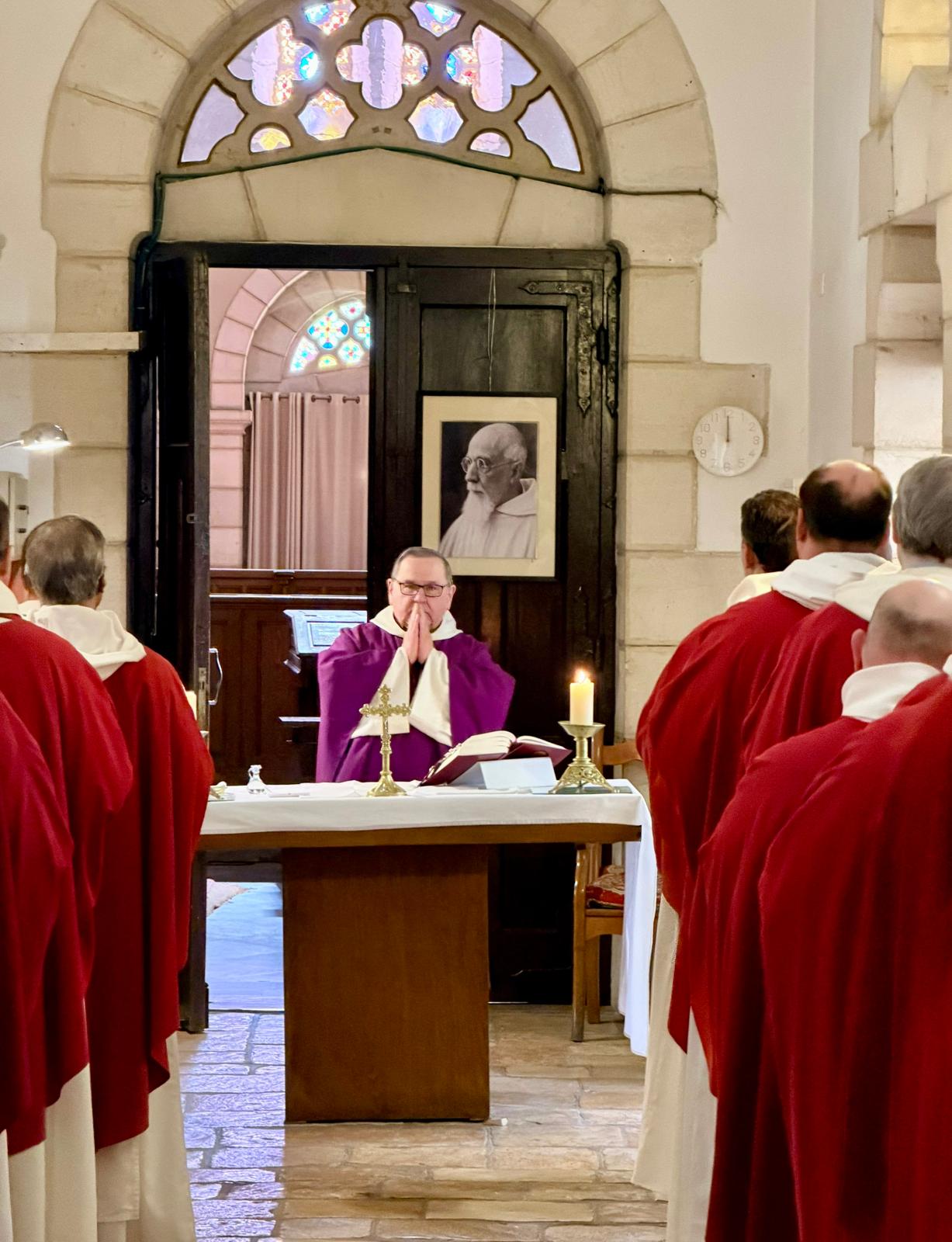
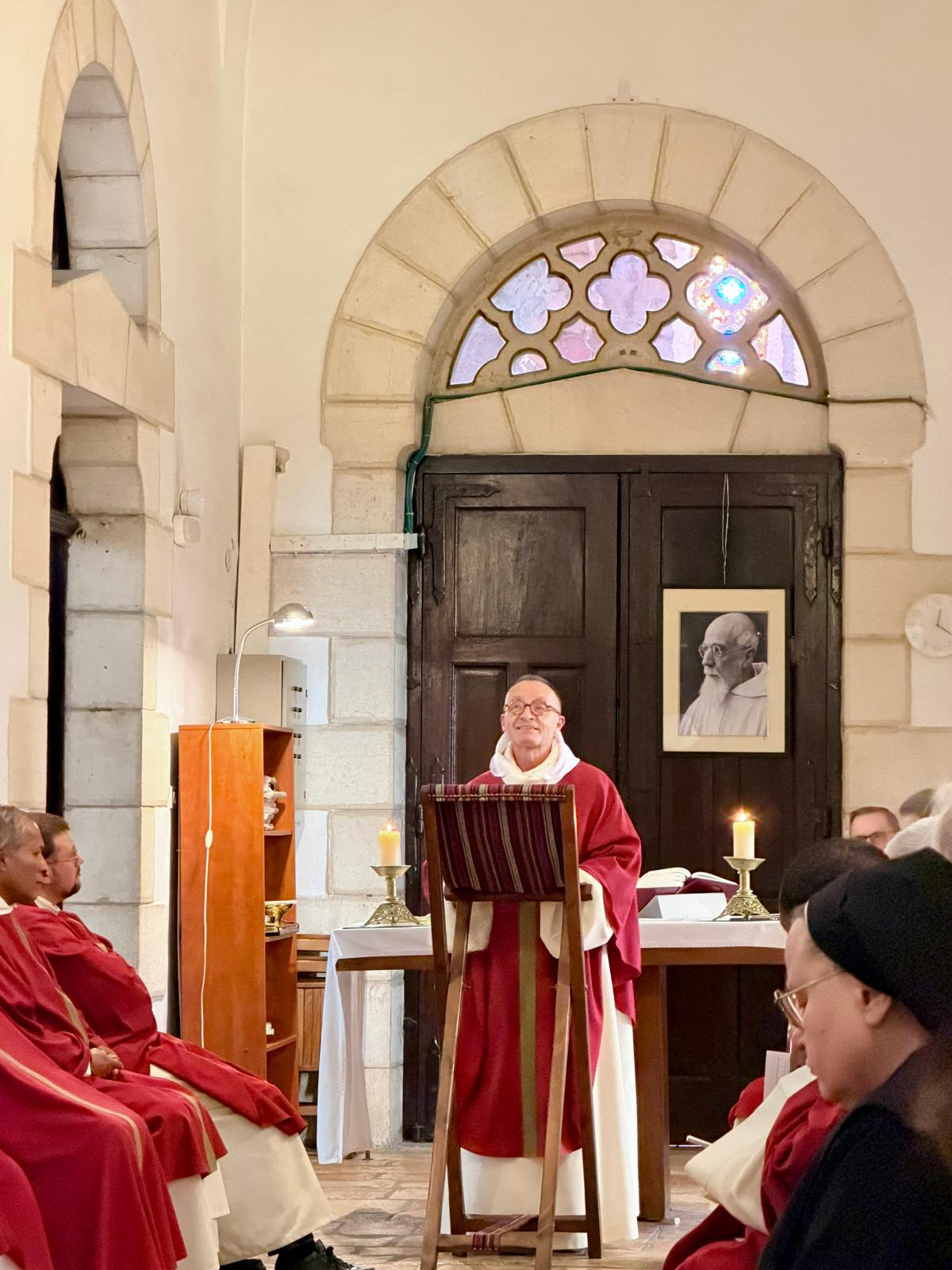
In view of the current emergency situation, the commemorative Mass was celebrated at noon in the shelter used by the community in the event of an alert. The celebration was presided over by the prior, Fr Stanisław Gurgul, and the homily in remembrance of the life and work of Father Lagrange was preached by Fr Olivier-Thomas Venard.
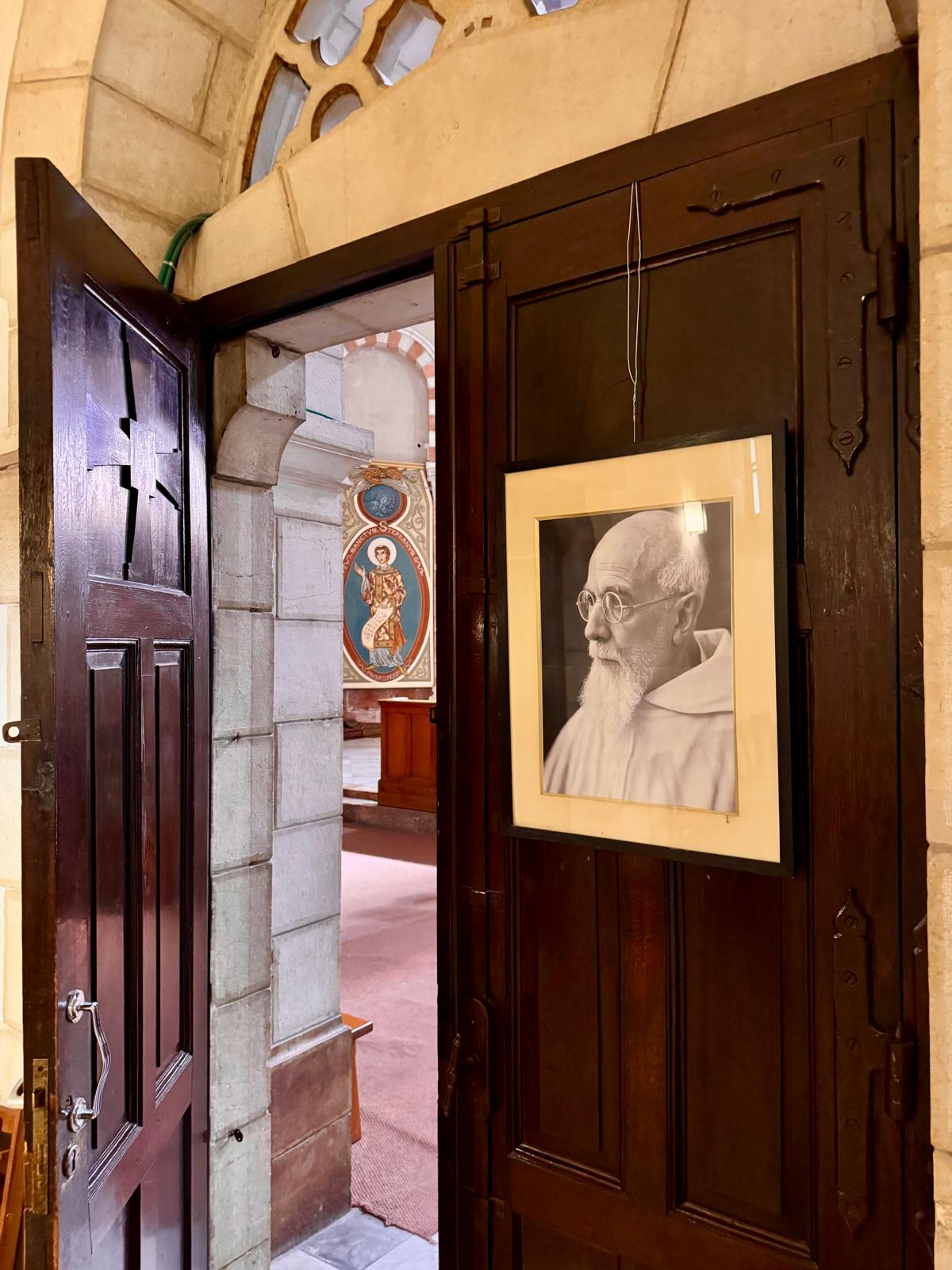
Behind the altar, a recently restored photographic portrait of Father Lagrange was displayed. It will soon be installed beside the side altar of Saint Jerome in the Basilica of Saint Stephen.
We also present here to our readers the full text of the homily delivered on this occasion. The text below is an English translation of the homily.
Homily of Fr Olivier-Thomas Venard OP
to honour the memory of our founder,
Fr Marie-Joseph Lagrange OP
10 March 2026, anniversary of his birth into heavenOur prior, Fr Stanislaw Gurgul, wished that on this anniversary of his being called to God we should recall the memory of Fr Marie-Joseph Lagrange, the founder of our beloved École.
On this seventy-eighth anniversary of the death of Fr Marie-Joseph Lagrange: “Let us now praise famous men” (Sir 44:1), the panegyric of one whom we hope one day to see beatified and given as an example to the whole Church. Marie-Joseph Lagrange was a hero of science, of patience, of conscience and of trust.
At a time when various discoveries from the archaeological and historical sciences seemed to threaten the Christian tradition, Marie-Joseph Lagrange was first of all a hero of science. Rather than being content with arguments from authority — the weakest in what reason can attain — he decided to learn, to study and to research in order to answer questions where they arose: textual criticism, grammar and ancient history.
“Facts — let us look at the facts, and let us not forget that it is biblical facts which must prevail over our reasons of convenience and our habits of mind” (MH 82).
He cultivated the asceticism of study. Formed in Dominican life in the tradition of austere observance that Fr Cormier had impressed upon the Province of Toulouse, Fr Lagrange worried that in the convent of Jerusalem the austerities of rising in the night, fasting and abstinence were not possible. He discovered that the true asceticism is that which corresponds to one’s personal vocation.
During the retreat of 1895 he wrote the following in his journal:
“May I work only out of love, without any desire to learn what is not useful for salvation. […] Practise the discipline of the mind. Be very strict with regard to all useless reading — newspapers, journals… As far as possible, read with pen in hand for reviews or notes on Scripture, analyses that may be useful. And seek recreation in prayer.”
What a model for us!
The result was more than nineteen thousand printed pages, if my memory is correct, which our colleague and friend Fr Maurice Gilbert, an eminent Jesuit biblical scholar, read in their entirety as doctrinal censor for the cause of canonisation — as an act of penance, he said — for the persecutions that his Jesuit confrères inflicted upon the poor Fr Lagrange, and which would take too long to enumerate here.
For the results of his studies did not please everyone, particularly those who would have liked the work of a priest to be marked by the “pious sweeteners” he detested, dedicated as he was to establishing the “biblical facts”, sometimes surprising for those attached to pious legends, but necessary for the religion of the Incarnate Word, who himself said that he is the king of those who seek the truth.
In his own words:
“We would not wish that souls should be lost for refusing their assent to what the Church does not ask them to believe” (RB 6, 1897, 341–79).
In doing so he carried out discernments in every direction that have lost none of their relevance. It is enough to quote these few lines from his famous Historical Method, written more than 120 years ago:
“The first condition for practising a sound historical method is to ask of history only what it can give; and when one has measured its gaps and its insufficiencies […] one can only thank God for having placed Holy Scripture and the whole system of faith in a region that depends no more exclusively upon history than upon philosophy” (MH 15).
Marie-Joseph Lagrange was a hero of patience — of endurance and resilience: even after his death he endured persecution.
While Pope Leo XIII had encouraged him to found the École, his successors were suspicious and went so far as to forbid him to publish on certain subjects or to work in certain areas. Even when Pius XII paid tribute to the work of Fr Lagrange in his great biblical encyclical Divino afflante Spiritu, it was nevertheless without naming him.
To the point that Archbishop Sambi, former Apostolic Delegate in Israel-Palestine, once told us here that Fr Lagrange experienced the trial of living too early among people who died too late.
He lived these trials under the gaze of God, as mortifications that sanctified him. Let us listen again to his journal in 1897:
“In the apostolic and scholarly life one thinks one can dispense with many mortifications […], but Our Lord is accustomed to compensate for this by criticisms, reproaches and injustices from the world or even from religious: we must rejoice that he does not leave us without his Cross.”
In all these trials Fr Marie-Joseph was also a hero of conscience: he knew how to obey both the legitimate authorities of the Church and the imperatives of his conscience enlightened by his studies.
— The ecclesiastical authorities, because, as he himself writes:
“We follow an excellent method by practising criticism without ever losing sight of the authority of the Church, because the very rule of criticism is to take account of the milieu, and the Church is precisely the milieu in which Scripture appeared” (MH 19).
— And the authority of his conscience, for he never called true what he had established to be false, nor the reverse in order to please some ignorant authority; but neither did he disobey when that authority was legitimate: he left his work unpublished, or proposed to change his field of study.
What allowed him to stand on this narrow ridge of the true seekers of truth was his love for Christ, nourished by the liturgy.
Let us listen again, on page 2 of the first issue of the Revue biblique:
“I love to hear the Gospel sung by the deacon at the ambo, amid the clouds of incense: the words then penetrate my soul more deeply than when I encounter them in a journal discussion.”
The learning of Fr Lagrange was not the cold science of a forensic doctor dissecting the text on his table with little concern for the real Presence that pulses within it. It was a lived science, conscious of the consequences of his work for the souls of those less learned, whom he wished to strengthen in faith and in trust in God and in the Church.
For Fr Marie-Joseph Lagrange was finally a hero of trust: in Providence, in his brothers who would not abandon him (even the Blessed Fr Cormier, Master of the Order, severe though he was, defended him before St Pius X), and above all in Jesus, whose love was the fixed point of all his work.
The work of Fr Lagrange contains a secret that has still not been sufficiently emphasised: his safeguard against all relativism was not some bourgeois moderation against the “excesses” of criticism, but a profound conviction which he calls “the fundamental dogma of the divinity of Jesus” (MH 28), and which is a lived spiritual experience in the line of St Thomas Aquinas and the masters of the French school of spirituality.
When he speaks of it, his language becomes almost Anselmian:
“Religion aims to bring us closer to God; the most perfect is that which unites us to him most fully. When the union is such that the mind can conceive nothing more intimate, we have reached the absolute as far as man is capable of sharing in it. What our Catholic religion proposes for us to believe is that God united himself to the human race through the Incarnation, that he unites himself to us through the Eucharist and through grace, in order to unite us to himself in glory. It seems that it is enough to state these things to recognise that it is impossible to go further in the religious order” (cf. MH 5).
As a true Dominican, Fr Lagrange never separated prayer from study. During the last three years of his life, at Saint-Maximin, he would go before the grotto of Lourdes to recite the prayer “O Jesus living in Mary”, received from his teachers at Saint-Sulpice and placed at the beginning of his Gospel according to Saint Matthew:
“O Jesus living in Mary, come and live in your servants, in the spirit of your holiness, in the fullness of your strength, in the perfection of your ways, in the truth of your virtues, in the communion of your mysteries. Rule over every hostile power within us by your Spirit and for the glory of the Father. Amen.”
Fr Olivier-Thomas Venard OP
Prayer for the glorification of the Servant of God Fr Marie-Joseph Lagrange, in English