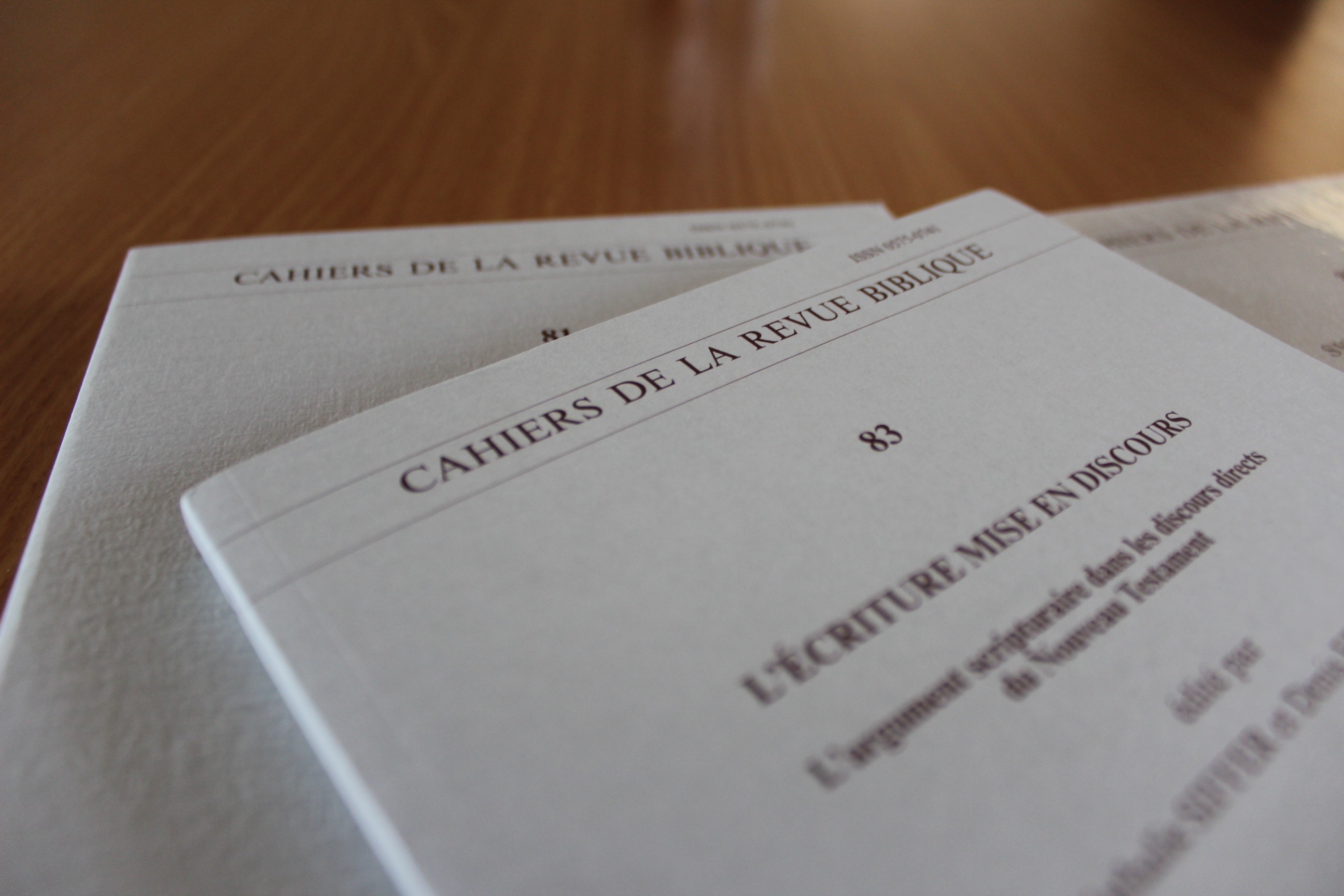
Volumes of the Cahiers de la Revue Biblique

Publications · since 1964

The Cahiers de la Revue Biblique

Published since 1964, the Cahiers de la Revue Biblique – the secondary series of the École – welcome works on more limited subjects that nonetheless go beyond the usual scope of a journal article. Since 1982, the series has been open to submissions in the more common European languages.

1964Cahiers (CRB) founded
80–220 p.per volume
1982Open to European languages
2017Series Archaeologica

Since their creation, the two series – the Cahiers de la Revue Biblique (CRB, founded in 1964, volumes of 80 to 220 pages), with their Series Archaeologica, and the Études Bibliques (EtB, founded in 1900, volumes of 200 to 500 pages) – have reflected the breadth of exegetical debate, covering themes from the whole of biblical literature and its related disciplines, insofar as they relate to the chosen biblical theme. Particular importance is given to source research.

Since 2017, the CRB Series Archaeologica has published specialised works on archaeological subjects.

The most recent issues (2016-2022)

2022The topography of ancient Jerusalem : essays on the urban planning record, defences and gates : 2ⁿᵈ century BC – 2ⁿᵈ century ADby Dominique-Marie Cabaret, O.P. ; translated from the French by David Orton
2022Sur les pas des arpenteurs romains : la via nova de la Provincia arabia entre Bostra et Philadelphia, Vol. 2, Khirbet es-Samrapar Gérard Thébault
2021Palestinian traditional pottery : a contribution to Palestinian cultureJohn Landgraf, Owen Rye ; editors Elizabeth Burr, Jean-Baptiste Humbert, Owen Rye, [et al.]
2021Le mariage dans l’œuvre de Flavius Josèphe : une étude du droit matrimonial en ses sourcespar Bertrand Pinçon
2021Le prophète s’avance masqué : commentaire et traversée biblique du livre de Jonaspar Claude Lichtert
2019 · N°94La purità e il cuore dell’uomo. Indagini lessicali e percorsi teologici attorno a καθαρόςMarco Settembrini, Éd. Peeters, Leuven, 2019, 199 p.
2018 · N°93L’ecclésiaste à la confluence du judaïsme et de l’hellénisme. Deux siècles d’histoire des études comparées du Qohélet et des vestiges littéraires et philosophiques grecsPaul-Marie Fidèle Chango o.p., Éd. Peeters, Leuven, 2018, 179 p.
2018 · N°92The Hebrew Bible of Josephus. Main FeaturesÉtienne Nodet o.p., Éd. Peeters, Leuven, 2018, 286 p.
2018 · N°91Un maître de la critique textuelle : Dominique Barthélemy. L’édition de la ‘Critique textuelle de l’Ancien Testament’ (1982-2015)Adrian Schenker o.p., Clemens Locher, H.G.M. Williamson, Éd. Peeters, Leuven, 2018, 68 p.
2017 · N°86Coelé-Syrie. Palestine, Judée, PéréeAnca Dan, Étienne Nodet o.p., Éd. Peeters, Leuven, 2017, 144 p.
2017 · N°90Le dossier Jézabel. L’imaginaire de la « femme royale » entre Bible hébraïque, cultures hellénisées et monde romainPaolo Garuti o.p., Éd. Peeters, Leuven, 2017, 180 p.
2017 · N°88Colegio del Pilar. Excavations in Jerusalem, Christian QuarterChrista Clamer, Kay Prag, Jean-Baptiste Humbert o.p. (eds), Cahiers de la Revue Biblique Series Archaeologica, Éd. Peeters, Leuven, 2017, 168 p.
2017 · N°89Texte et sommaires des « Antiquités » de Josèphe. Éditions multiplesÉtienne Nodet o.p., Éd. Peeters, Leuven, 2017, 189 p.
2016 · N°87« Souvenez-vous ! » La mémoire sélective de l’épître de JudePierre de Martin de Vivies, François Lestang (eds.), Éd. Peeters, Leuven, 2016, 151 p.

The latest publications of our series can be found on our Publications page.

For authors

If you would like to publish your work in one of the series, please contact the Series Editor, Martin Staszak.

staszak@ebaf.edu

1Manuscripts submitted for publication are forwarded to the editorial board.

The members of the board are:

Françoise Briquel Chatonnet (Paris)Yunus Demirci (Jerusalem)Anthony Giambrone (Jerusalem)Daniel Machiela (Notre Dame, USA)Gudrun Nassauer (Fribourg, Switzerland)Łukasz Popko (Jerusalem)Martin Staszak (Jerusalem)

2The criteria for acceptance are:

  1. The relevance of the topic within the scientific discussion. The topic must be sufficiently specific: introductions or topics that are too general cannot be considered.
  2. The quality and breadth of the scientific argumentation, consideration of the respective state of discussion within and outside theological debate, including counter-positions, respect for the opinions of others, regardless of one’s own convictions, and the achievement of a result that makes a significant contribution to the discussion.
  3. The comprehensible and concise presentation of the topic and one’s own scientific argumentation; this must not be exclusively limited to a particular school or use terminology that only insiders understand, even in the professional world.
  4. The formal presentation of the work according to standard practices (e.g. through indexes).
  5. The series, especially the Études Bibliques, also want to promote young scholars and publish their qualifying works. Only above-average works are considered for this.
  6. The series are designed to be international and publish in the five languages agreed with the publisher (French, English, German, Italian, Spanish).

3If necessary, the respective representatives may, after consultation with the series editor, ask other experts for their opinion.